Welcome to the world of
Pluto Lands |

maxresdefault

Unique Orbit

Pluto’s orbit is unusual because it is highly stretched (elliptical) and tilted compared to the flat orbits of most planets. It also crosses the path of Neptune but never collides due to a stable gravitational resonance.

Frozen planet

Pluto is a frozen world far from the Sun, with surface temperatures around −230°C. It is covered in ice made of nitrogen, methane, and carbon monoxide, giving it an extremely cold and icy landscape.
Dwarf planet

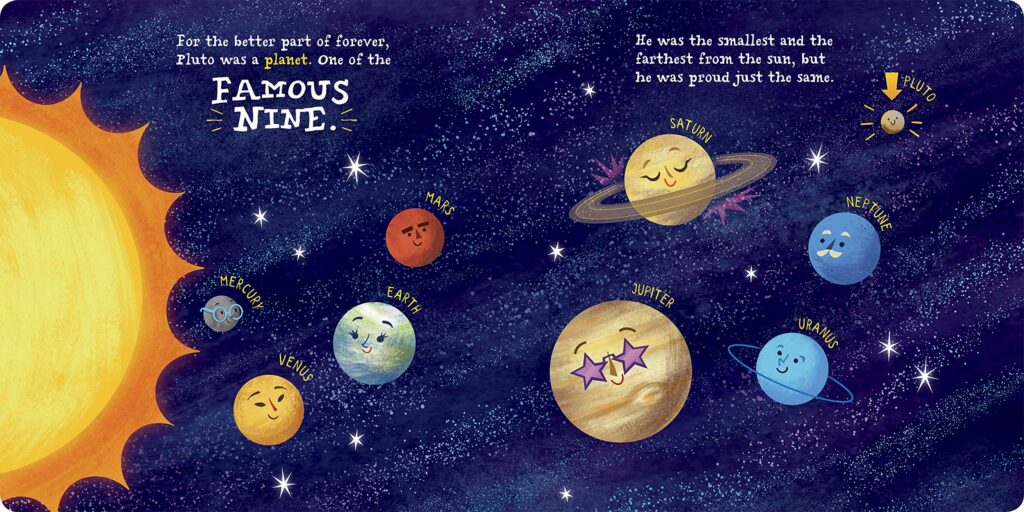
Pluto is a dwarf planet located in the outer region of the solar system. It was reclassified from a planet to a dwarf planet in 2006 due to its size and inability to clear its orbit.
About Pluto

Pluto is a small, icy world located far beyond the major planets in a region called the Kuiper Belt. Once known as the ninth planet, it was reclassified as a dwarf planet in 2006. Pluto is extremely cold, has a unique tilted and elongated orbit, and is accompanied by five moons, the largest being Charon, which is nearly half its size.

Mission to pluto

NASA’s New Horizons mission is the first probe to study Pluto, its moons and other worlds within the Kuiper Belt up close. It was launched on January 2006, and successfully made its closest approach to Pluto on July 14, 2015.  The New Horizons probe carries some of the ashes of Pluto’s discoverer, Clyde Tombaugh. The limited knowledge of the Pluto system created unprecedented dangers for the New Horizons probe. Prior to the mission’s launch, scientists knew of the existence of only three moons around Pluto. The discovery of Kerberos and Styx during the spacecraft’s journey fueled the idea that more satellites could orbit the dwarf planet, unseen from Earth. Collisions with unseen moons, or even small bits of debris, could have seriously damaged the spacecraft. But the New Horizons design team equipped the space probe with tools to protect it during its journey. In October 2021, New Horizons made history when it returned the first close-up images of Pluto and it’s moons.

Scroll to Top